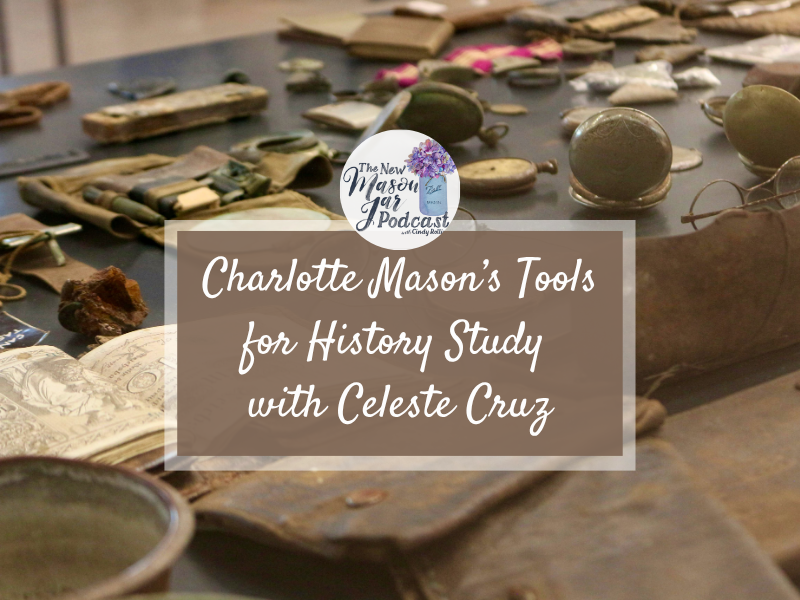
S10E139: Charlotte Mason’s Tools for History Study with Celeste Cruz
This, then, is the purpose of narration—a purpose which we would do well to keep constantly before us. There should be no misconception. It is not a teacher’s device designed to find out if the child has completed a given task. It is not an act of verbal memory. It is a process which makes all the difference between a child knowing a thing and not knowing it. Narration is, indeed, like faith, the substance of things hoped for, the evidence of things not seen. It is the method whereby the child assimilates what he reads.
Stanley Boardman, from The Parents’ Review, Vol. 38, p. 469-475
Show Summary:
- Today on The New Mason Jar, Cindy and Dawn are joined by Celeste Cruz, Charlotte Mason homeschooling mom of eleven and executive director of the CMEC
- How Celeste came to know about Charlotte Mason’s philosophy
- Some opening thoughts on CM’s approach to history through both books and other things
- What are some of the tools we can use for studying history, and what is their natural progression?
- How does Celeste work these tools into her own homeschool?
- What is the value of these tools when students are already narrating?
- Why is it so important to consider the teacher’s role in using these history study tools?
- How can we support our students in the process?
Listen Now:
Books and Links Mentioned:
CMEC’s 2024 Retreat Package – Time and Eternity: The Student’s Pursuit

Find Cindy, Dawn and Celeste:
Cindy’s Patreon Discipleship Group
Mere Motherhood Facebook Group
The Charlotte Mason Education Center Website
Subscribe:
No lesson is valuable which does not promote self-activity by making the child think, exercising its powers of narration or reproduction, or laying the ground-work for some future mental habit, making the idea given a well-spring of activity. We can judge, then, of the value of a lesson by the amount of work which it gives the children to do. There is, therefore, in a really good lesson only one place for the teacher, and that is the background.
Miss R.A. Pennethorne, from The Parents’ Review, Volume 10, p. 551-552
Therefore, we teachers often have to pass a self-denying ordinance, and instead of showing off to our children how much we know, we take our children to the fountain-heads of knowledge and stand by in “masterly inactivity” while they drink.

